
ARTICLE
The Quantifiable Impact of: Modern Aviation MRO Platforms vs. Legacy On-Premise SystemsMarch 2026
Ty Myers, Chief Revenue Officer, Impresa Corp.
Key Takeaways:
- Cloud MRO platforms deliver measurable performance gains
- Faster turnaround time directly improves profitability
- Lower infrastructure and integration costs drive ROI
- Real-time data improves compliance and audit readiness
- Cloud enables scalability, collaboration, and future innovation
From Legacy Systems to Measurable MRO Performance
The aviation Maintenance, Repair, and Overhaul (MRO) sector is undergoing the most significant digital transformation in its history. With global MRO demand projected to exceed $282 billion by 2030, organizations are reassessing whether legacy on premise systems can keep up with escalating operational, regulatory, and supply chain pressures.
Modern, cloud native MRO platforms promise measurable gains in efficiency, cost, and reliability. But how do these improvements translate into quantifiable impact when compared directly to traditional on premise MRO applications? Below, we examine the hard numbers supported by recent industry research.
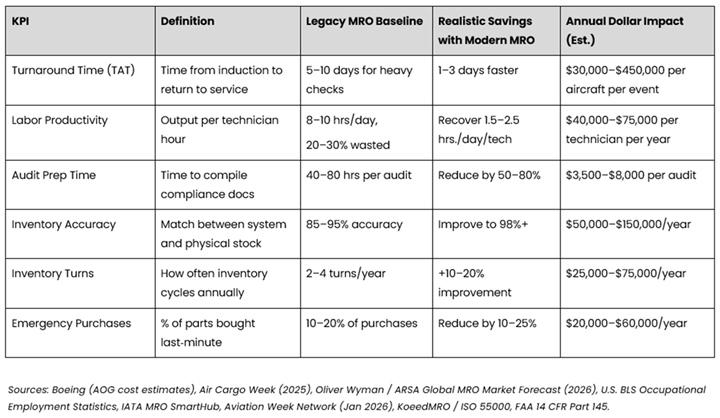
1. Operational Efficiency: Consistently, Faster Turnaround Times (TAT)
Turnaround time remains the single largest driver of MRO profitability and fleet readiness—and cloud platforms materially outperform their legacy counterparts.
Cloud Impact
Cloud native systems enable real time data sharing between technicians, tooling, parts inventory, and planning systems across global locations. This substantially reduces delays caused by siloed data and manual processes. Industry reports highlight that cloud platforms provide real time visibility into maintenance schedules, inventory, and compliance needs, which directly accelerates task sequencing and execution.
Legacy Limitations
On premise systems struggle with fragmented workflows, slow hand offs, and outdated interfaces. Labor intensive processes remain a key bottleneck, especially when technicians must rely on paper forms or disconnected terminals. Labor inefficiencies are a primary driver of increased TAT and cost.
Quantifiable Difference
- Cloud enabled predictive planning via AI-powered insights has been shown to reduce maintenance delays significantly, enabling smarter scheduling and optimized resource allocation.
- Airlines in the U.S. have faced a 15% increase in maintenance costs and a 14% rise in flight delays in recent years—pressures cloud MRO systems are specifically designed to mitigate.
2. Cost Reduction: Lower Infrastructure & Integration Overhead
Cloud Impact
Cloud platforms eliminate the need to manage complex hardware, reduce IT staff overhead, and remove the financial burden of maintaining aging servers and databases. Deployment flexibility and scalability also help avoid capital expenditure spikes during fleet expansion or regulatory update cycles. Cloud has now become the dominant deployment model in aviation MRO due to flexibility and cost effectiveness.
Legacy Limitations
On premise systems introduce:
- High fixed infrastructure costs
- Costly upgrades
- Expensive custom integrations
- Data trapped in outdated formats, increasing modernization costs
Hybrid environments attempting to bridge legacy systems introduce additional integration complexity and operational overhead.
Quatifiable Difference
Organizations transitioning away from legacy infrastructure report:
- Lower operating costs due to decreased hardware and maintenance burden
- Reduced downtime by avoiding extended system outages common in legacy environments
- Smoother scaling as fleet sizes and regulatory requirements grow
3. Regulatory Readiness & Audit Accuracy
Cloud Impact
Modern systems ensure real time compliance, digital traceability, and centralized workflow management covering people, parts, tools, files, and data. This alignment with FAA/EASA mandates significantly reduces audit risk and improves airworthiness management accuracy.
AI driven health monitoring platforms integrated with cloud MRO suites provide validated maintenance data, enabling MCC teams to shift from reactive troubleshooting to proactive planning.
Legacy Limitations
- Manual validation of fault histories
- Inconsistent record-keeping
- Delayed visibility into compliance gaps
- Increased regulatory exposure
Quantifiable Difference
Cloud systems provide digital, audit ready accuracy that can reduce compliance related delays and rework—key contributors to annual operational costs.
4. Workforce Productivity & Global Collaboration
Cloud Impact
Cloud deployment enables seamless collaboration across distributed maintenance centers.
Global MRO teams benefit from:
- Shared real time data
- Remote accessibility
- Reduced manual handoffs
Cloud native systems provide the digital speed required to replace legacy workflows and support modern workforce expectations.
According to industry surveys, 43% of MRO organizations cite digital capability as a top priority due to labor constraints and increased maintenance workloads.
Legacy Limitations
On premise systems rely heavily on local availability and are poorly suited for globally distributed operations or hybrid work models.
5. Scalability, Security, and Long-Term Sustainability
Cloud Impact
Cloud-native solutions:
- Scale effortlessly across fleets, sites, and regions
- Offer built in security updates and disaster recovery
- Support AI, analytics, and automation natively
The 2025–2026 MRO trends report notes that analytics, integration, and automation are now the top investment priorities—and cloud platforms are the only environment capable of supporting them effectively.
Legacy Limitations
- Upgrades often take months and require downtime
- Security vulnerabilities accumulate as infrastructure ages
- Limited capacity to support modern AI/ML tools
Conclusion: The Data Shows a Clear Winner
Across every quantifiable dimension—cost, efficiency, compliance readiness, collaboration, and scalability—modern cloud aviation MRO applications deliver transformative advantages that legacy on premise systems simply cannot match.
The aviation industry’s shift toward cloud-native MRO systems is not just a technological upgrade; it represents a strategic imperative to remain cost competitive, compliant, and operationally agile in an increasingly complex global environment. With cloud adoption now the dominant deployment preference in aviation technology evaluations, the transition away from legacy systems is accelerating across fleets, sectors, and regions.
If your organization is still relying on a legacy on premise MRO system, the evidence is clear: modernizing today isn’t just beneficial—it’s essential for tomorrow’s operational resilience.
Learn more at impresa-us.com
© 2026 Impresa Corp. All rights reserved.
This case study and its contents are the intellectual property of Impresa Corp. No part of this publication may be reproduced, distributed, or transmitted in any form or by any means—electronic mechanical, photocopying, recording, or otherwise—without the prior written permission of the publisher, except in the case of brief quotations used in critical reviews or scholarly works.
Impresa Corp. retains all rights to the methodologies, case studies, and concepts presented herein. For permissions or licensing inquiries, please contact info@impresa-us.com
Disclaimer: The information provided in this whitepaper is for general informational purposes only. While every effort has been made to ensure the accuracy and completeness of the content, Impresa Corp. makes no warranties, express or implied, and assumes no legal liability for the use of this information. Readers are encouraged to seek professional guidance specific to their operational or regulatory requirements.