
TOOLKIT
AVIATION MRO DIGITAL OPERATIONAL READINESS TOOLKITFebruary 2026
Executive Value Summary
- 1 – 3 days faster turnaround
- 1 – 2 technician hours recovered per day
- 50 – 80% reduction in audit prep effort
- Lower AOG and expedited procurement costs
INTRODUCTION
Modern Maintenance Requires Connected and Intelligent Execution
Aviation Maintenance, Repair, and Overhaul (MRO) organizations operate across component repair, complex assemblies, and full airframe maintenance programs. Each discipline introduces unique operational, regulatory, and workforce coordination challenges that require precision, consistency, and execution transparency.
Maintenance leaders today face increasing pressure to reduce turnaround time while delivering predictable execution outcomes, strengthening audit readiness, and improving enterprise-wide visibility, all while maintaining uncompromising safety standards.
Legacy maintenance platforms were designed primarily to manage transactions and record historical maintenance activity. Modern MRO organizations require platforms that orchestrate execution across people, parts, tools, files, and data while enabling workforce mobility, remote collaboration, and disaster-resilient operations.
Audit Readiness Master Checklist
Industry transformation is accelerating. Market research indicates that more than 70 percent of enterprise software buyers now expect artificial intelligence-enabled capabilities as part of digital modernization initiatives. Maintenance organizations evaluating new solutions increasingly prioritize predictive insight, automated workflow intelligence, and real-time execution visibility.
This toolkit provides practical, field-tested resources designed to help MRO organizations transition from fragmented execution models to connected, digitally orchestrated maintenance performance.
THE COST OF REMAINING ON LEGACY MRO SYSTEMS
Many maintenance organizations continue operating on legacy MRO platforms originally implemented years or decades ago. While these systems often delivered significant value during initial deployment, they increasingly introduce operational limitations that restrict modernization and competitive growth.
Common legacy platform challenges include:
- Limited remote and mobile workforce accessibility
- Execution disruption during system outages or facility events
- Heavy reliance on manual workflow coordination
- Fragmented compliance documentation and audit preparation
- Increasing third-party integration and customization costs
- License-restricted workforce participation
- Reduced ability to scale operations efficiently
Organizations maintaining legacy systems frequently experience diminishing operational returns while facing increased competitive pressure from digitally enabled MRO providers.
Modern execution platforms enable organizations to improve throughput consistency, workforce efficiency, and operational resiliency while reducing total cost of ownership.

SECTION 1: AUDIT READINESS AND EXECUTION TRACEABILITY
Compliance as an Operational Discipline
Maintenance organizations must maintain continuous audit readiness. Regulatory compliance is not a periodic event — it is a daily operational discipline supported by standardized workflows, automated documentation, and traceable execution records.
Document Completeness
- Digitally document all work orders
- Ensure procedures align with approved manuals
- Maintain revision-controlled maintenance documentation
- Validate technician certification and training records
Digital Sign-Off Validation
- Capture technician credentials for every maintenance task
- Route approvals through standardized workflow processes
- Ensure electronic signatures meet regulatory standards
Traceability Verification
- Track serialized parts usage and certification documentation
- Maintain complete historical maintenance records
- Capture inspection and test results digitally
Compliance Monitoring
- Confirm adherence to national aviation agencies and
regulatory standards - Validate quality inspection checkpoints
- Document and trace corrective actions
SECTION 2: STANDARDIZED MRO WORKFLOW EXECUTION FRAMEWORK
Reducing Variability to Improve Maintenance Predictability
Workflow variability is a primary driver of maintenance delays, rework, and compliance risk. Standardized execution templates improve consistency across component repair,
engine overhaul, avionics maintenance, and airframe operations.

Work Order Execution Framework
Step 1: Work Package Planning
- Define maintenance scope and procedures
- Assign documentation and compliance requirements
- Identify parts and tooling requirement
Step 2: Technician Assignment Assign qualified personnel based on certification
- Confirm skill and training alignment
- Schedule maintenance tasks and labor allocation
Step 3: Parts and Tool Verification
- Confirm parts availability and certification
- Validate tool calibration status
- Ensure documentation access at point of execution
Step 4: Execution and Documentation
- Digitally record maintenance actions
- Capture inspection checkpoints and technician observations
- Maintain real-time workflow visibility
Step 5: Approval and Sign-Off
- Route approvals through standardized digital workflows
- Validate compliance checkpoints
- Archive documentation in traceable audit records
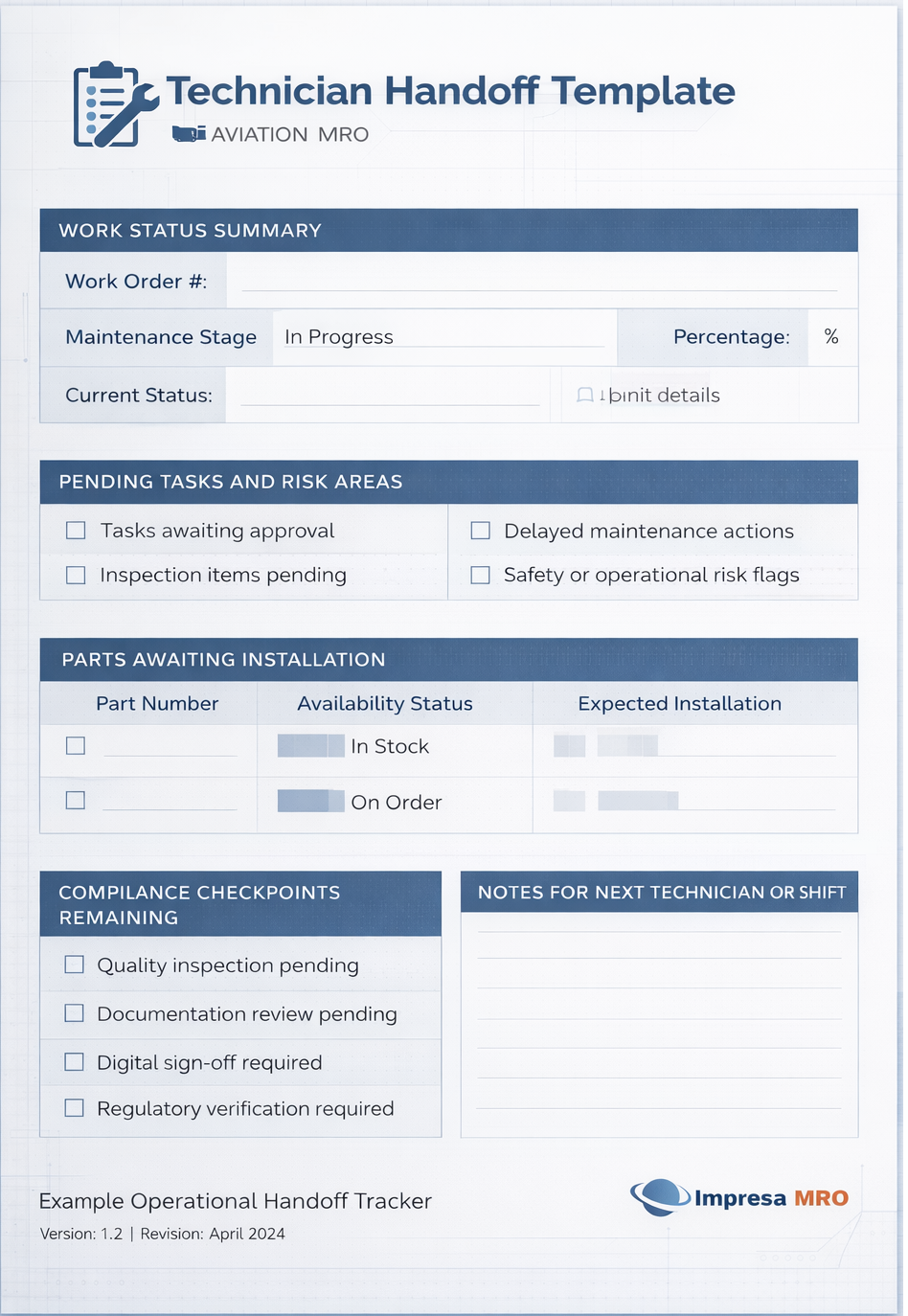
Technician Handoff Template
Work Status Summary
- Work order number
- Maintenance stage
- Completion percentage
- Execution status
Pending Tasks and Risk Areas
- Tasks awaiting approval
- Delayed maintenance actions
- Inspection items pending
- Safety or operational risk flags
Parts Awaiting Installation
- Part number
- Availability status
- Certification verification
- Expected installation timeline
Compliance Checkpoints Remaining
- Quality inspection pending
- Documentation review pending
- Digital Sign-Off requirements
- Regulatory verification requirements
Add Space for Notes for Next Technician or Shift
SECTION 3: OPERATIONAL VISIBILITY AND PERFORMANCE INTELLIGENCE
Driving Performance Through Real-Time Maintenance Insight
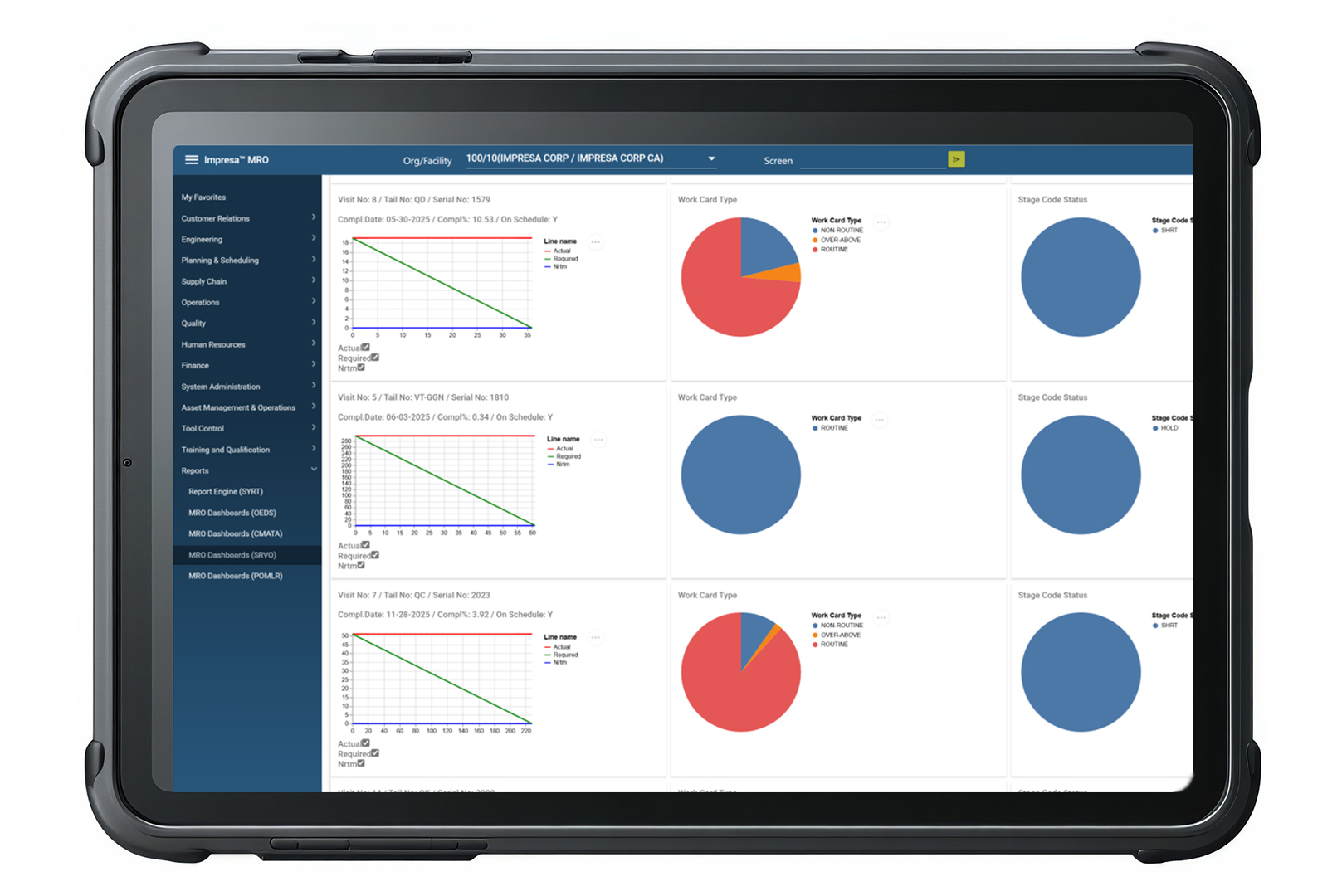
Maintenance leaders require continuous visibility into execution performance, compliance readiness, and operational bottlenecks. Real-time dashboards provide decision-makers with actionable insight that improves planning accuracy, workforce coordination, and customer confidence.
Recommended Maintenance Performance KPIs
Execution Performance Metrics
- Work order completion rate
- Technician productivity and utilization
- Maintenance cycle time
- Rework and error rates
Compliance Metrics
- Audit readiness scoring
- Documentation completion rate
- Digital sign-off compliance tracking
Operational Efficiency Metrics
- Parts availability delays
- Workflow bottleneck identification
- On-time maintenance completion performance
AI-Enabled Maintenance Execution
Emerging AI technologies are transforming maintenance planning, resource allocation, and compliance validation. AI-driven maintenance platforms enable predictive workflow insights, automated anomaly detection, and intelligent execution recommendations that improve maintenance consistency and reduce operational risk.
SECTION 4: MRO DIGITAL TRANSFORMATION ROADMAP
Structured Modernization Framework
Successful digital transformation focuses on operational improvement rather than technology implementation alone.
Phase 1: Current State Assessment
- Evaluate existing workflow processes
- Identify manual documentation dependencies
- Assess compliance risk exposure
- Measure current performance baselines
Phase 2: Workflow Standardization
- Develop standardized execution templates
- Implement digital approval routing
- Establish compliance verification checkpoints
Phase 3: Technology Integration
- Connect maintenance execution systems
- Integrate parts tracking and documentation workflows
- Implement digital traceability infrastructure
Phase 4: Target State Implementation
- Deploy standardized digital workflow processes
- Train technicians and maintenance leadership teams
- Measure performance improvements against baseline metrics
Phase 5: Future State Vision
Define the long-term digital maintenance ecosystem including:
- AI-driven predictive maintenance execution
- Automated compliance validation and reporting
- Enterprise-wide workforce mobility
- Real-time customer maintenance transparency
- Fully connected maintenance orchestration
SECTION 5: WORKFORCE PRODUCTIVITY AND COLLABORATION
Supporting Technician Efficiency and Operational Coordination
Maintenance workforce challenges continue to impact execution performance. Providing technicians with connected workflows, mobile documentation access, and automated data capture significantly improves productivity while reducing administrative workload.
Workforce Optimization Checklist
- Reduce manual data entry requirements
- Provide mobile access to work instructions and documentation
- Automate compliance documentation workflows
- Improve technician collaboration and communication tools
- Establish automated workforce performance measurement dashboards
Business Continuity and Execution Resiliency
While most maintenance organizations maintain disaster recovery strategies, traditional approaches frequently focus on data backup rather than execution continuity.
For example, a turbine MRO provider experienced a facility shutdown caused by a neighboring facility fire. Although physical operations remained intact, system outages prevented customer communication and workflow visibility for over one week.
Modern digital maintenance platforms provide execution continuity by enabling secure remote access, distributed workflow visibility, and real-time collaboration across maintenance teams and customers.
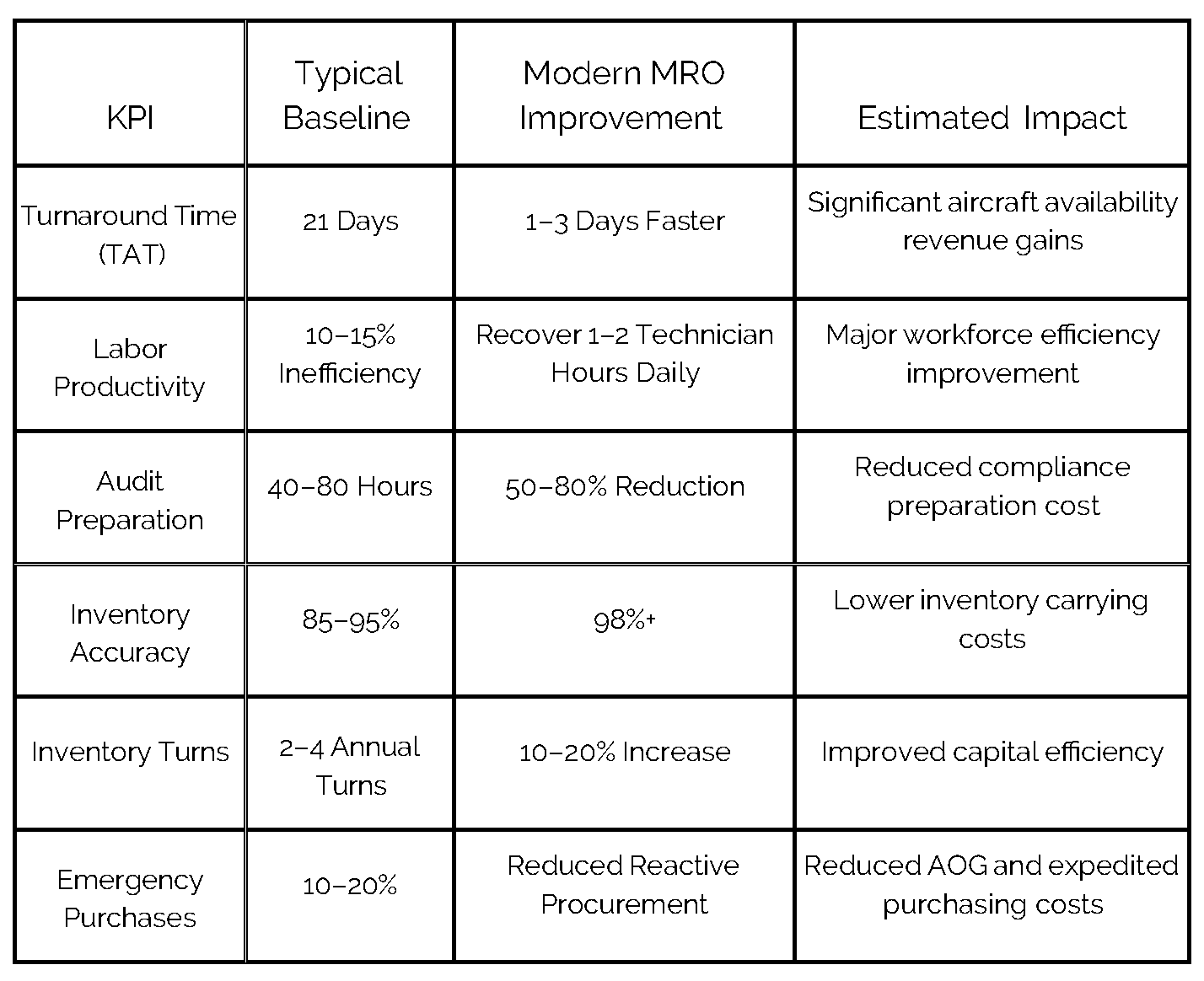
Financial Impact of MRO Modernization
Modern maintenance execution platforms generate measurable financial and operational
value.
What If Modern Execution Could Deliver:
- Consistently faster maintenanceturnaround
- Enterprise-wide workforce accessfrom any location or device
- Reduced compliance preparationworkload
- Increased throughput predictability
- Lower operational risk and total cost ofownership
CONCLUSION
Maintenance organizations that implement connected execution platforms achieve:
Feature: Digital workflow orchestration across maintenance operations
Advantage: Accelerated modernization and competitive differentiation
Benefits:
- Faster and more predictable turnaround performance
- Reduced compliance risk exposure
- Increased technician productivity
- Lower total maintenance execution cost
- Improved customer retention and acquisition
Organizations that remain on legacy maintenance platforms should not expect increased throughput, faster execution, or improved operational resiliency in increasingly competitive and dynamic aviation maintenance markets.
ABOUT IMPRESA
Impresa Corp delivers next-generation aviation MRO software that unifies people, parts, tools, files, and data into a single, orchestrated platform. Designed by aerospace professionals, Impresa MRO helps airlines, OEMs, and third-party providers reduce turnaround time (TAT), improve compliance, and lower total cost of ownership. With flexible self-hosted deployment and real-time visibility, Impresa enables organizations to meet today’s challenges and the future demands of aviation maintenance.
NEXT STEPS
Organizations exploring workflow modernization, compliance improvement, or maintenance
execution optimization can learn more about Impresa MRO solutions at: impresa-us.com
© 2026 Impresa Corp. All rights reserved.
This document and its contents are the intellectual property of Impresa Corp. No part of this publication may be reproduced, distributed, or transmitted in any form or by any means—electronic mechanical, photocopying, recording, or otherwise—without the prior written permission of the publisher, except in the case of brief quotations used in critical reviews or scholarly works.
Impresa Corp. retains all rights to the methodologies, case studies, and concepts presented herein. For permissions or licensing inquiries, please contact info@impresa-us.com
Disclaimer: The information provided in this document is for general informational purposes only. While every effort has been made to ensure the accuracy and completeness of the content, Impresa Corp. makes no warranties, express or implied, and assumes no legal liability for the use of this information. Readers are encouraged to seek professional guidance specific to their operational or regulatory requirements.